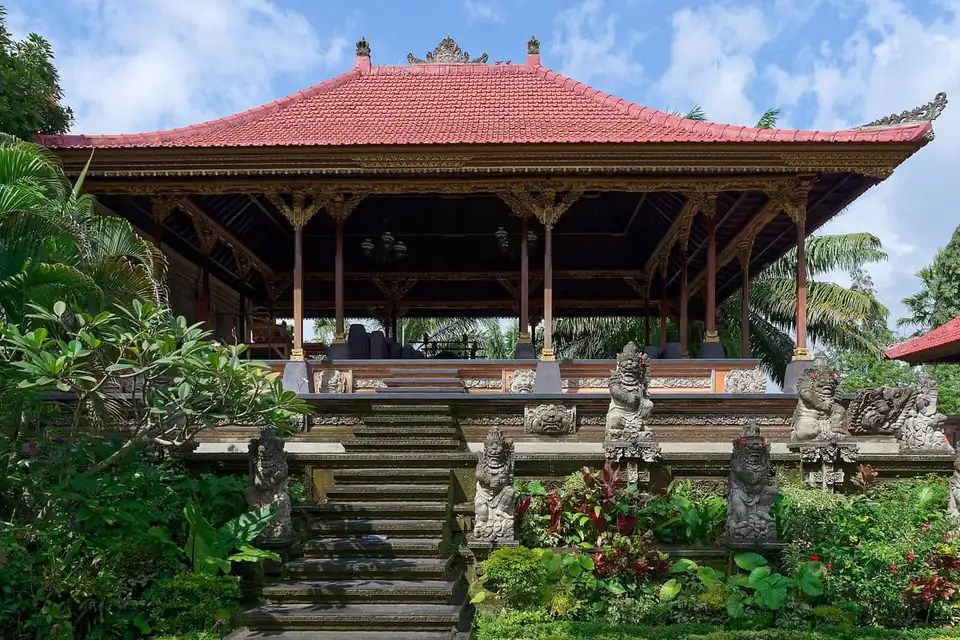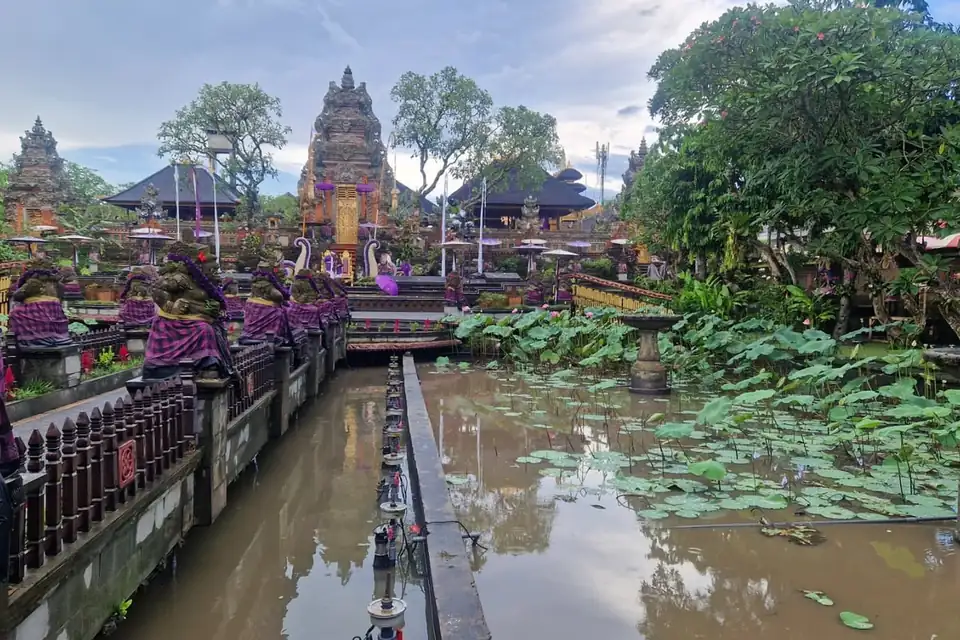
Pura Taman Saraswati is the temple in the centre of Ubud that most people know as the water palace. Its official name is Pura Taman Kemuda Saraswati, and it is dedicated to Saraswati, the Hindu goddess of learning, literature and the arts. The reason to come is the approach: a straight causeway through a lotus pond to a set of red-brick gates.
It sits on Jalan Kajeng, behind Cafe Lotus, a short walk from Ubud Palace.
A 1950s temple by Ubud’s master builder
The temple is newer than it looks. It was commissioned by the prince of Ubud, Cokorda Gede Agung Sukawati, and built in 1951 and 1952 to designs by I Gusti Nyoman Lempad.
Lempad was Ubud’s great builder: a stone carver, painter and undagi, the Balinese term for an architect of ritual structures such as cremation towers. He had come to Ubud from the royal court of Blahbatuh after falling out with its king, and worked for the Sukawati family on palaces and temples across Ubud and its neighbouring villages. His birth date is not known, but he was already married when Krakatoa erupted in 1883, so he was well into his eighties when he built this. He died in Ubud on 25 April 1978.
Many of the statues along the causeway are his own work, carved in paras, the soft volcanic tuff used across Bali.
Reading the gate and the courtyard
Frangipani trees line the edges of the pond. At the end of the causeway are three kori agung gates in red brick; the central one is the largest and is flanked by two tall frangipani.
If you look straight through the central gate, you do not see into the temple. The view is blocked by an aling-aling, a wall placed to disorient evil spirits. Here the wall is the back of a 3 metre statue of Jero Gede Mecaling, a demon figure.
Inside, which you will see only from the gate, the padmasana shrine in the most sacred northeast corner stands on a carved cosmic turtle and nagas and is topped by an empty golden throne for Acintya, the highest deity. A pavilion holds three empty thrones for Brahma, Vishnu and Shiva, and the bale barong keeps two barong figures used in village exorcism rites, the lion-like Barong Ket and the boar-like Barong Pangkal. There is also a statue of Saraswati. Look for her in the reliefs on the walls and gateways as well, where she is shown holding a manuscript and a veena, the symbols of knowledge and the arts.
Dance in front of the pond
Most evenings the space in front of the temple becomes a stage, with the lit gates behind the dancers. Shows start at 7.30pm and tickets were about Rp 100,000 in 2023. Wikivoyage lists it alongside the palace as a venue with performances almost nightly.
Fees, hours and the Saraswati festival
Admission has changed. A 2023 report from detikBali called the temple free; IDN Times the same year gave Rp 35,000 for foreign adults and Rp 25,000 for children; Wikivoyage listed Rp 60,000 in 2025. Plan on paying, with cash. Quoted hours range from 7am to 5pm and from 9am to 6pm.
The inner sanctum is for people coming to pray, and Bali’s provincial guidance for foreign visitors keeps non-worshippers out of the inner and middle courtyards of temples. Dress modestly.
Every six months, on Saraswati day, Balinese Hindus pray to the goddess of knowledge, and in Ubud this temple is where they come. It is one of the busiest temples on the island that day, so check the date before you plan a quiet visit. For more Lempad, the Museum Puri Lukisan stands not far away on Jalan Raya Ubud, just west of the market. It opened in 1954 as the first private museum in Bali, is open daily from 8am to 4pm, and shows work by Lempad and Rudolf Bonnet among others. Combine it with the palace and the market nearby, and see the full list of things to do in Ubud.