
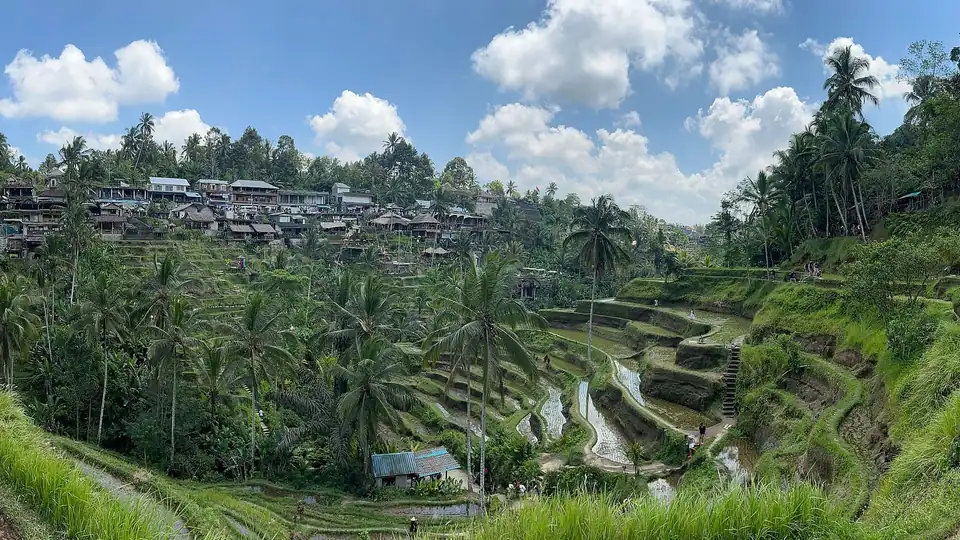
Long before Bali became known for its temples and terraces, the island was a frontier of the great Austronesian expansion, one of the widest movements of people in human history. Farming communities carried rice, livestock and the skill of the seafarer across the Indonesian archipelago, and in Bali they found volcanic soil, steady rain and rivers that could be turned to the plough. Out of these villages grew the ancestor cults, the bronze casting and, in time, the literate kingdoms whose inscriptions still stand.
This early history is written in stone drums, carved pillars and terraced hillsides rather than in chronicles. It runs from the first farmers, through the Bronze-Iron Age and the arrival of Indian religious ideas, to the Warmadewa kings who left the oldest dated record in 914 CE. So much of later Balinese life, from the water temples to the reverence for sacred mountains, is rooted in something far older than any single kingdom.
The Austronesian foundation
The decisive chapter in Bali’s peopling began around four thousand years ago, when Austronesian-speaking farmers moved south through the islands that now make up Indonesia. They were not the first humans to set foot in the region, but they brought a way of life that would endure. With them came wet and dry rice farming, the domestication of pigs and chickens, weaving, pottery and the outrigger boats that made island-hopping possible.
These settlers cleared and planted the land, and the bonds of kinship and shared labour they built still shape the Balinese village today. Their languages are the direct ancestors of modern Balinese, part of the vast Austronesian family that stretches from Madagascar in the west to the Pacific islands in the east. From the start, Balinese society turned on the rhythms of the farming year and the authority of ancestors, two themes that run through every later period of the island’s history.
Bronze, iron and the Pejeng Moon
By the last centuries BC, Bali had entered the metal ages, part of a wider Southeast Asian world that prized bronze ritual objects. The finest surviving expression of this era sits in the village of Pejeng, near Ubud, where the temple of Pura Penataran Sasih guards an enormous bronze kettledrum known as the Pejeng Moon. Standing close to two metres tall and cast as a single hourglass-shaped piece, it ranks among the largest bronze drums found anywhere on earth.
The drum’s surface carries geometric bands and stylised faces, and its scale points to a society able to organise skilled metalworkers, secure the tin and copper needed for bronze, and invest great effort in sacred objects. Balinese tradition holds that the drum is a wheel that fell from the moon, and it is still treated as holy. Whether it was cast on the island or imported, the Pejeng Moon shows that Bali was woven into the trade and ritual networks of the Bronze-Iron Age long before written history began.
Megalithic ancestors and sacred mountains
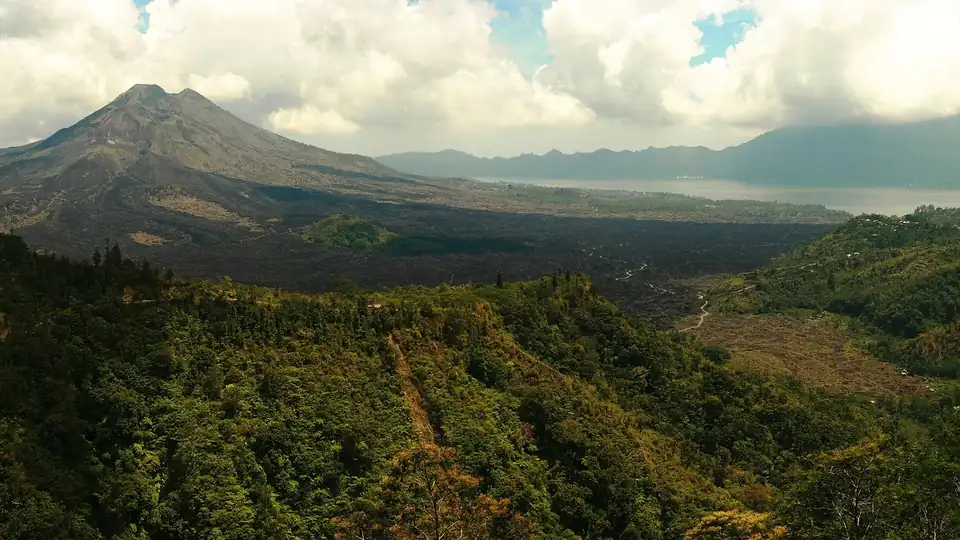
Alongside metalworking, Balinese communities kept a strong tradition of ancestor worship expressed in stone. They raised terraces, stepped platforms, stone seats and standing stones, monuments meant to seat the spirits of the dead and to bind the living to their forebears. This megalithic culture connected the community to the land and, above all, to the mountains, where ancestors and gods were thought to dwell.
The idea that high ground is holy and the sea is a place of danger became a lasting feature of Balinese religion. Villages were oriented towards the mountains, temples faced the peaks, and the great volcanoes came to be seen as the seats of the divine. Traces of this early world survive in the highland districts around Bangli and Kintamani, where the terraced layout of old villages and their ancestral shrines still echo the megalithic pattern.
Indian ideas and the coming of writing
From roughly the eighth century, a new set of influences reached Bali. Hindu and Buddhist ideas, Sanskrit vocabulary, Indian-derived scripts and the architecture of the temple spread across maritime Southeast Asia through trade and the movement of priests and scholars. Bali absorbed these currents both directly and through its powerful neighbour, Java, where great Hindu-Buddhist states were already rising.
Crucially, the new ideas did not sweep the old ones away. Indian concepts of gods, kingship and cosmic order were layered onto the existing animist and ancestral beliefs, producing a blend that is uniquely Balinese. Sanskrit terms entered ritual and administration, temple forms grew more elaborate, and the practice of recording royal acts in writing took hold. This fusion is the taproot of the island’s living faith, described further in our overview of Balinese religion.
The Warmadewa kings and Bali’s first records
The moment when Bali steps into written history comes at Sanur, where a stone column called the Blanjong pillar carries an inscription dated to 914 CE. Written partly in Old Balinese and partly in Sanskrit, it records the deeds of a king named Sri Kesari Warmadewa. It is the earliest dated document on the island, and it reveals a court with literate officials, a ruling dynasty and connections to the wider Indianised world.
The Warmadewa line ruled parts of central Bali through the tenth century. Later inscriptions name further members, including Queen Mahendradatta, a Javanese princess, and her husband King Udayana around the year 1000. Their marriage tied the Balinese court more closely to Java and helped bring Javanese religion, law and courtly culture to the island. From these rulers the thread runs directly to the great Javanese connection of the following centuries, told in our history of Hindu Bali and the Majapahit refuge.
The birth of the subak
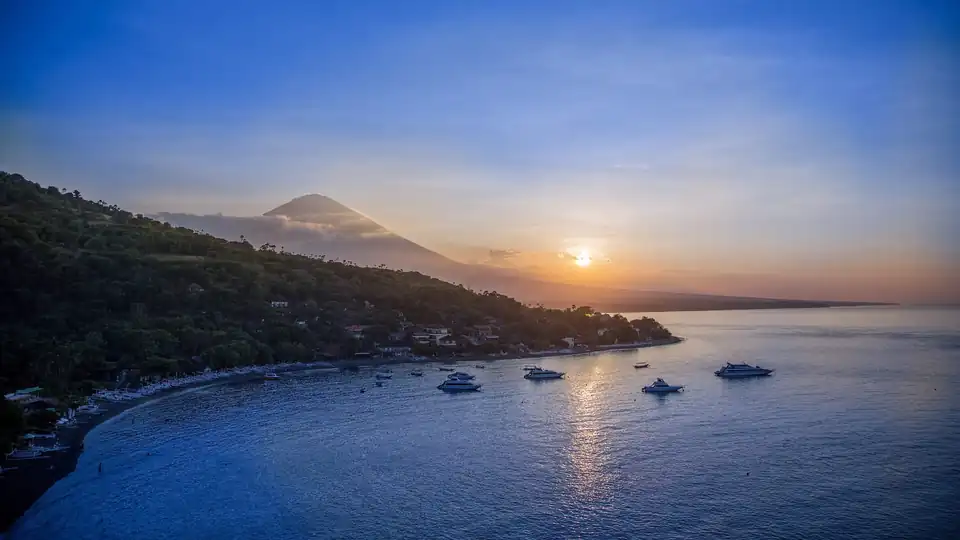
Perhaps the most enduring legacy of early Bali is not a monument but a system. As villages spread across the volcanic slopes, farmers learned to channel water from springs and rivers down through terraced fields, sharing a single source among many holdings. The organisation that grew up to manage this, dividing the water fairly, timing the planting and maintaining the canals, is the subak.
A subak is more than an engineering committee. Each is tied to water temples where farmers make offerings and coordinate the flow of water according to a ritual calendar, binding practical farming to the Hindu philosophy of balance between people, nature and the divine. Developed over many centuries, the subak network still governs rice growing across much of the island and was recognised as a UNESCO World Heritage cultural landscape in 2012. In it, the deep history of Bali is not a relic but a living inheritance, visible in every terrace you pass on the road up to Ubud and the highlands beyond.