
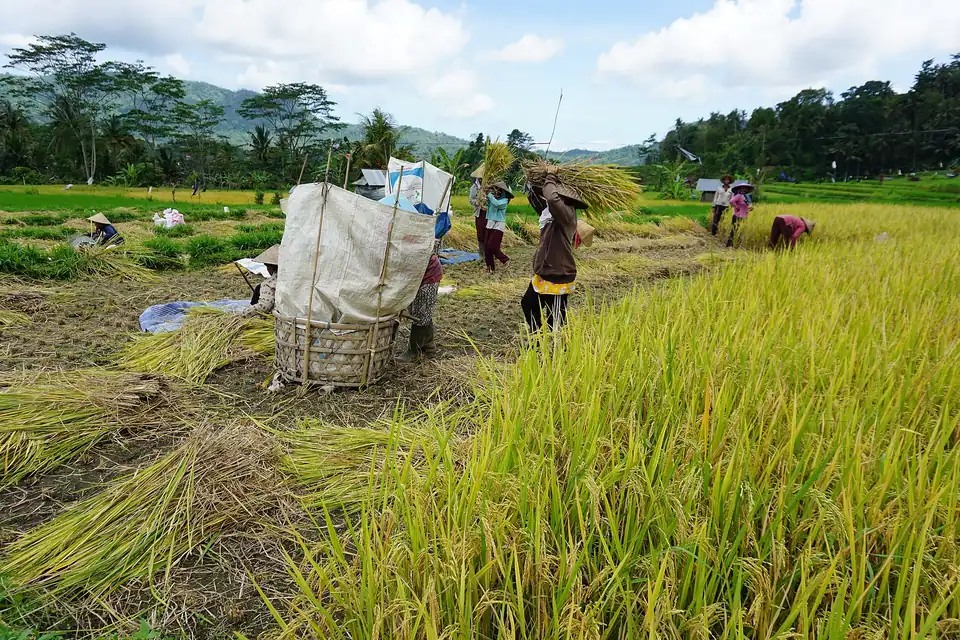
Sidemen is a quiet valley of rice terraces in the Karangasem regency of east Bali, with Mount Agung rising above the fields on a clear morning. It is a farming district rather than a resort area: terraces step down to a river, small villages sit among the fields, and weavers work in family workshops along the road. People come to walk, to sleep with the windows open and to see a side of the island that the south coast has largely lost.
The valley sits well away from the main tourist routes. Most visitors travel from Ubud or the south coast, and many then go on to the diving coast around Amed further north-east. This page covers the valley, the drive and the weather.
Why visit Sidemen
An August 2026 guide describes it as a quiet agricultural valley of rice fields, small villages, rivers and views of Mount Agung, and says the area feels different early in the morning and late in the afternoon once the day-trippers leave. The same guide suggests staying at least two nights, and that is sensible advice: one night barely covers a walk and a meal.
It is also a place to be honest about what is missing. There is no beach, no surf and very little nightlife, according to the same August 2026 guide. Dining means warungs, cafes and hotel restaurants. Many properties are open-air or semi-open-air, so geckos, insects and cooler nights come with the setting, and some bamboo villas rely on fans rather than strong air conditioning.
The climate is mild. The same guide gives an average temperature of around 20°C to 28°C year-round, with mornings and evenings that feel cool after the coast. Mist and sudden showers are common because of the surrounding mountains, so carry a rain jacket even on a sunny day.
Stays range from bamboo houses to small guesthouses beside the fields. Where to stay in Sidemen compares the three village groups where they sit, and for the wider choice of areas on the island, see where to stay in Bali.
The rice terraces and valley walks
The terraces are the reason most people come. A May 2026 guide describes tiered fields that you can walk through on cooler mornings, wading across calm rivers and passing farmers at work. The same guide notes that, unlike Jatiluwih, the Sidemen terraces are not a UNESCO world heritage site, so the fields are working farmland and not a protected showpiece.
An August 2026 guide singles out the area around the Yellow Bridge and Tabola village for some of the most scenic rice field walks in Bali. One of the popular trails asks for a donation to cross its fields, so carry small notes. The May 2026 guide advises wearing proper shoes, carrying water because it gets hotter after midday, and remembering that the fields are private working land.
You can walk alone, but a local guide adds context on the farming and the village. The May 2026 guide puts the cost of a guide in Sidemen village at approximately 300,000 IDR, and suggests shopping around. If you prefer to see more ground, a scooter is the usual way to explore the lanes between villages, though the roads are steep and slippery after rain.
The scenery changes through the year. The August 2026 guide says the rice fields are usually harvested twice a year. Its advice is that April to May and September to October are the safest months for green fields, while June or November often bring golden fields just before harvest.
Gembleng Waterfall is the usual short outing. The May 2026 guide describes a 20 minute drive from Sidemen village and a five minute walk up steps to rock pools at the top with views over the valley. Entry is by donation (that guide gave 20,000 IDR). The same guide says the site is holy and was used for melukat, a Balinese cleansing ceremony, and that it can close to the public during ceremonies, so keep to the edges and give local bathers space.
The Telaga Waja river is the other draw. A French-language guide from October 2025 describes the rafting route as around 16 km, taking 2 hours 30 minutes to 3 hours, with an instructor on board for beginners. A January 2025 guide gives the activity as around 2 to 3 hours. Check the water level when you book, as the river runs lower or higher with the weather.
Songket weaving and village life
Sidemen is known for traditional songket and endek weaving. The August 2026 guide says some family-run workshops allow visitors to watch the process, and the May 2026 guide recommends visiting a workshop to buy textiles made on wooden looms. It says the hand-made sarongs take around a month to complete and cost approximately 2 million IDR, which gives a sense of the labour.
Beyond weaving, an August 2026 guide lists silver-making classes and Balinese cooking classes among the things to do, many run by villas and local restaurants. The valley also has a morning market, and the French-language guide mentions a small hilltop temple, Pura Bukit Sangkan Gunung, reached in about 10 minutes of walking from Sidemen village by a steep staircase.
The May 2026 guide also mentions ceremonies that take over a whole street and farmers working the paddies at sunset. Keep your distance from ceremonies and dress modestly near temples.
Mount Agung views and the temples nearby
Mount Agung dominates the horizon. The May 2026 guide describes it as visible from anywhere in the area and puts its height at over 3000 metres. It is a sacred mountain to the Balinese, and the same guide says many locals climb to pay respects at the temple near the summit. The mountain is a one hour drive from Sidemen by that guide.
Climbing is a serious undertaking. The May 2026 guide describes two routes: Pura Pasar Agung, reaching the crater edge at 2866 m in 4 to 5 hours, and the Pura Besakih route to the highest summit at 3142 m, which takes 6 to 8 hours. Both are physically demanding, often begun around midnight. The guide says there has not been a serious eruption since 2017, but advises checking local news and warnings and going with a local guide, particularly in the dark.
For a view without the climb, go to Lahangan Sweet. The Lahangan Sweet viewpoint is a village-run ridge in Bunutan that looks straight at Mount Agung, with the sea on the other side. It lies on the coast side of the mountain, about 30 minutes by road from Amed, and Pura Lempuyang is 3.8 km away, about 12 minutes by road.
Two temples are the big names for this part of Karangasem. A January 2025 guide calls Besakih the Mother Temple of Bali, the largest and holiest temple complex on the island, on the slopes of Mount Agung. It gives about an hour from Sidemen, while the French-language guide says about 35 minutes, so allow up to an hour. The same January 2025 guide puts Lempuyang, the temple known for its Gates of Heaven, at about an hour from Sidemen, and advises arriving early to avoid crowds.
Other stops mentioned by these guides are Tirta Gangga water palace, about 45 minutes from Sidemen by the May 2026 guide, where entry is 50,000 IDR plus 10,000 IDR for swimming, and Taman Ujung, built in 1909, open daily from 7 AM to 7 PM for 75,000 IDR. The same guide says Taman Ujung suffered significant damage in the 1963 eruption and has since been heavily restored.
Getting there and around
Sources differ on distances, so here are both. The August 2026 guide gives these drive times to Sidemen: Ubud 1.5 hours (37 km), Sanur 1 hour 30 minutes (42 km), and the airport 2 hours (60 km). A May 2026 guide says Ubud is only 33 km and typically about an hour, while a January 2025 account says 2.5 hours from Ngurah Rai airport. The honest range is 1 to 1.5 hours from Ubud and 2 to 2.5 hours from the airport.
The August 2026 guide recommends the coastal route via Goa Lawah when driving from the airport or south Bali, because the drive is smoother, and notes that travel times can increase significantly at peak traffic hours. The January 2025 guide also puts Padang Bai, the ferry port for the Gili Islands, at about 1 hour away.
A private driver is the easy way in. The January 2025 guide gives around IDR 400,000 to 700,000 (USD 25 to 45) depending on your starting point and bargaining. Our guide to a private driver in Bali covers what to ask and how to agree a price. Once there, a driver also makes the temples and waterfalls simple to link.
Ride-hailing is poor. The January 2025 guide says a return Grab or Gojek booking from Sidemen is unlikely. Scooters are the other option: the January 2025 guide gives IDR 60,000 to 150,000 per day, and the May 2026 guide says around 4 USD per day from a local shop. Roads are steep and winding, and slippery after rain, so this is not the place to learn to ride.
Carry cash. The August 2026 guide says smaller restaurants and warungs often prefer cash, that ATMs in the valley can be unreliable, and that it carries at least IDR 200,000.
Planning your visit
Plan around the weather and the crowds. The August 2026 guide gives May to September as the dry season, best for clear Mount Agung views and walking, and October to April as the rainy season, with greener terraces, stronger waterfalls, more mist and regular afternoon showers. It lists July, August and late December as the busiest times and April, May, June and September as the best balance. Our Bali month by month guide sets the valley against the rest of the island.
Two or three nights suits most trips: a morning on the terraces, an afternoon at a weaving workshop, and one day for a temple or the river. If Agung is your priority, book in the dry months.
Pack walking shoes, water shoes for the waterfalls, a rain jacket and a warm layer for the evenings. Bring cash, book your driver ahead and keep the itinerary light, because the valley rewards a slow pace.