
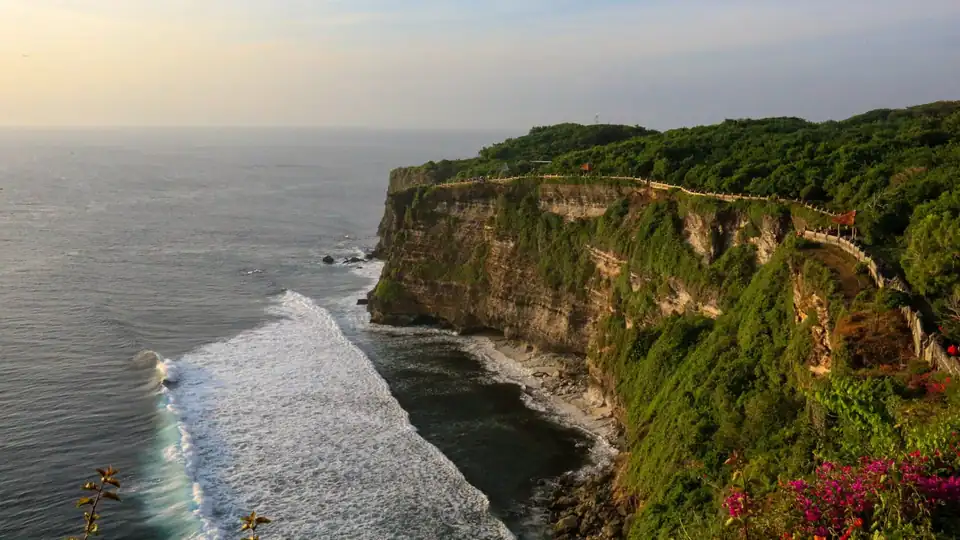
For a few centuries in the later Middle Ages, the island of Java was the seat of a brilliant Hindu-Buddhist civilisation whose greatest expression was the empire of Majapahit. When that world collapsed, its religion, literature and court arts did not vanish. They crossed the narrow strait to Bali and took root, so that a culture born in Java survived on the smaller island long after Java itself had turned to Islam. That is how Bali became the last home of the Hindu-Javanese golden age.
The story begins with the dynastic ties that already bound the two islands in the eleventh century, runs through the Majapahit conquest of 1343 and the rise of the Gelgel court, and closes with the great migration of priests, scholars and nobles who fled a falling empire. Their inheritance shaped Balinese religion, the caste order, and the classical arts of dance, drama and painting the island is known for today.
Airlangga and the Javanese bond
The links between Bali and Java were already old by the eleventh century, but they were made vivid in the person of Airlangga. He was born in Bali to the Javanese princess Mahendradatta and her Balinese husband, King Udayana of the Warmadewa line described in our history of early Bali. Airlangga grew up to rule a powerful kingdom in eastern Java, and his reign came to stand for the shared blood and culture of the two courts.
Through such marriages and alliances, Javanese religion, Old Javanese literature and courtly practice flowed steadily into Bali. The island was never a mere province of Java, and it kept its own kings and customs, but the two were bound together in a way that made later Javanese intervention almost a family affair. When Java’s rulers turned their eyes east, they came not as strangers but as cousins asserting a claim.
The conquest of 1343
That claim was made good in the fourteenth century by Majapahit, the last and greatest of the Hindu-Javanese empires. After an earlier raid by the kingdom of Singhasari in 1284, Majapahit mounted a full conquest of Bali in 1343. The campaign is bound up in tradition with Gajah Mada, the empire’s iron-willed chief minister, who had sworn to bring the islands of the archipelago under Majapahit authority.
The conquest ended the independence of the old Balinese kingdom centred at Bedulu, whose last ruler is remembered in legend as the tyrant Bedulu. In its place Majapahit set up a client court and planted a Javanese aristocracy on the island. The families descended from these newcomers would form the ruling class of Bali for the next five hundred years, and much of the island’s later social order dates from this moment of conquest.
Gelgel and the Balinese golden age
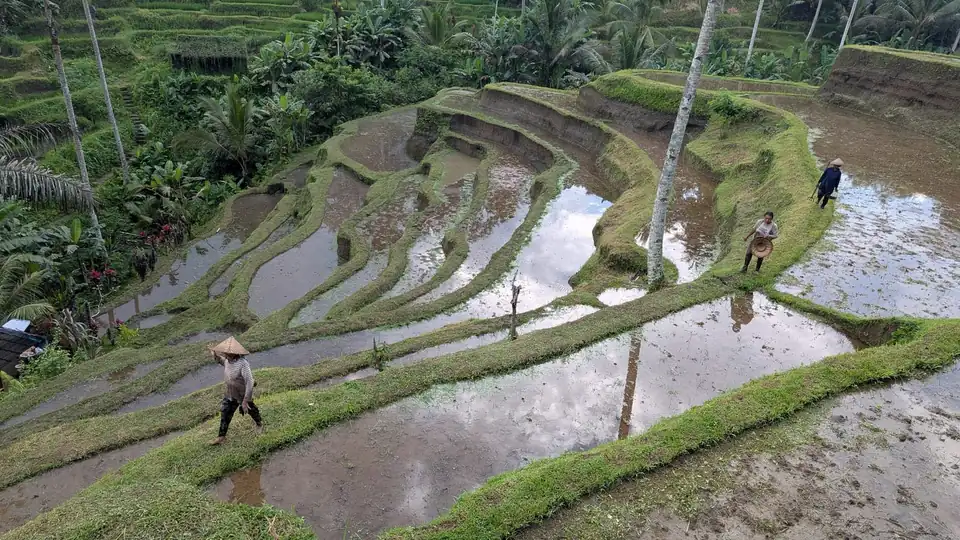
After the conquest the paramount court settled first at Samprangan and then at Gelgel, near modern Klungkung in the south-east. Under a line of kings who held the exalted title Dewa Agung, the Gelgel court reached its height in the fifteenth and sixteenth centuries and claimed authority over the whole island and beyond. This was the golden age of classical Balinese culture, when religion, literature and the arts were codified under royal patronage.
Tradition credits the priest Dang Hyang Nirartha, who came from Java in the sixteenth century, with reforming Balinese religion and founding or renewing many temples, among them the dramatic sea shrines of Uluwatu and Tanah Lot. Court poets composed and copied Old Javanese texts, temple architecture flourished, and the rituals and social forms of the island were given the shape they would keep. When Gelgel’s power later fractured, its prestige passed to the royal house of Klungkung, which continued to claim the senior rank among Balinese kings.
The fall of Java and the great migration
While Gelgel flourished, the world that had produced it was ending. Through the fifteenth century, Islam spread across Java, carried by traders and teachers, and the Majapahit empire weakened and broke apart around the year 1500. As the old order collapsed, many of Java’s Hindu priests, scholars, artists and nobles chose exile over conversion and moved east to Bali, where a Hindu court still reigned.
They brought with them the accumulated inheritance of centuries: sacred texts and the Old Javanese language in which they were written, the epics of the Ramayana and Mahabharata, styles of painting and sculpture, music and the codes of courtly life. Bali received this legacy and preserved it. In this way a civilisation that had grown up on Java survived on Bali after Java itself had become largely Muslim, and the island earned its lasting description as the last refuge of Hindu-Javanese culture.
Caste, the Bali Aga and a layered society
The Javanese inheritance reshaped Balinese society. From it came the catur wangsa, the four broad ranks that still order traditional life: the Brahmana priestly families, the Ksatria of royal and warrior descent, the Wesia, and the Sudra who make up the great majority of ordinary people. Balinese caste is not identical to the Indian system and touches mainly titles, ritual duties and etiquette, but its framework arrived with the courtly culture strengthened after 1343.
Not everyone accepted this order. Communities that trace their roots to before the Majapahit conquest, the Bali Aga or original Balinese, kept older customs and rejected the Javanese court model. Villages such as Tenganan in the east and Trunyan on Lake Batur preserve distinct rituals, forms of village self-rule and architecture to this day. Their survival is a reminder that the golden age, for all its brilliance, was layered onto a society that was already ancient.
The living inheritance
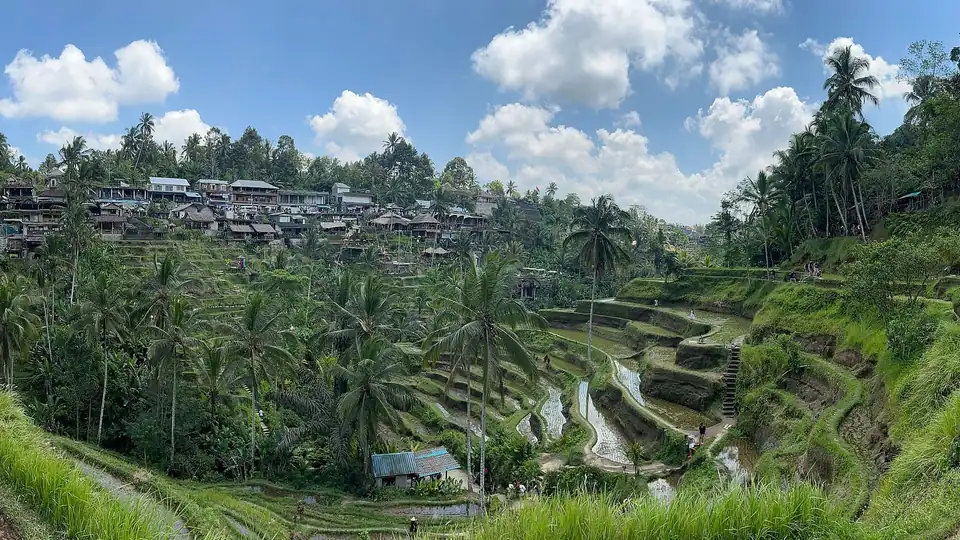
The reason this distant history still matters is that so much of it is alive. The Old Javanese texts recited by priests at Balinese ceremonies, the caste titles woven into daily courtesy, the masked dances and shadow plays that retell the Indian epics, and the painting traditions preserved around Klungkung all descend from the golden age. The gamelan music, the temple festivals and the offerings that fill the island’s ritual year rest on foundations laid in the centuries after Majapahit.
For a long time this world lay beyond the reach of outside powers, protected by Bali’s independence and its formidable kings. That independence would eventually be challenged from the sea by a European trading power, opening the harsh colonial chapter told in our history of Dutch colonial Bali. Before that, though, Bali had already done something remarkable: it had become the keeper of a golden age that its birthplace had forgotten.