
The two decades between 1942 and the late 1960s were among the most turbulent in Balinese history. In a single generation the island lived through foreign occupation, a war of independence, its absorption into a new republic, a catastrophic volcanic eruption and a wave of political killing. Bali entered these years as a quiet colonial possession and left them as a province of Indonesia, changed by suffering and loss.
The hard passage runs through the Japanese occupation of the Second World War, the fight against the returning Dutch that produced the hero Ngurah Rai and the Battle of Marga, Bali’s place in the new Republic of Indonesia, and finally the twin traumas of the 1963 eruption of Mount Agung and the violence of 1965 to 1966. It is the bridge between colonial Bali and the tourist island of today.
The Japanese occupation
The colonial order that the Dutch had imposed after the conquest, described in our history of Dutch colonial Bali, collapsed almost overnight in early 1942 when Japanese forces swept through the Indonesian archipelago. Japan occupied Bali with little fighting, and the small European community was interned. For the islanders the change was profound: the Europeans who had ruled them, and posed as the guardians of their culture, were suddenly gone.
The occupation lasted until Japan’s surrender in August 1945, and it brought real hardship. The Japanese requisitioned food and labour, and shortages and inflation pressed hard on ordinary people. Yet the occupation also shattered the myth of European invincibility and gave Indonesian nationalists room to organise and to arm. When Japan fell, Bali, like the rest of the archipelago, stood at a crossroads between a return to colonial rule and a leap towards independence.
Independence and the Balinese resistance
On 17 August 1945, two days after Japan’s surrender, the nationalist leaders Sukarno and Hatta proclaimed Indonesian independence in Java. The Dutch, however, meant to return and rebuild their empire, and a four-year revolution followed. On Bali the cause of the republic was taken up by young fighters, among them a former colonial officer named I Gusti Ngurah Rai, who organised a resistance force known as the Ciung Wanara.
The struggle on the island was fierce and unequal. Ngurah Rai’s men were poorly armed against returning Dutch troops with modern weapons, and they fought a guerrilla campaign across the countryside. The Balinese republicans drew on a deep local tradition of resistance to the death, and their story would end in a battle that echoed the puputan of the colonial conquest four decades before.
The Battle of Marga
On 20 November 1946, Ngurah Rai and his battalion were surrounded by Dutch forces near the village of Marga in Tabanan. Cut off and heavily outnumbered, they refused to surrender. In the fighting that followed almost the entire force was killed, Ngurah Rai among them. Balinese tradition remembers the battle as a modern puputan, a fight to the finish in the spirit of the royal courts of 1906 and 1908.
The sacrifice at Marga became a lasting symbol of Balinese devotion to the independence cause. Ngurah Rai was later honoured as a national hero of Indonesia, the Margarana monument was raised on the battlefield, and Bali’s international airport near Denpasar was named after him. Every visitor who lands on the island today arrives at a place that carries his name.
Bali joins the Republic
The revolution ended in December 1949, when the Netherlands transferred sovereignty and the Republic of Indonesia took shape. Bali became part of the new nation. After a period in which the country experimented with a federal structure, the unitary republic was consolidated, and Bali was established as one of its provinces, with Denpasar as its capital and a Balinese governor at its head.
For the island this meant a new political identity as one province among many in a vast archipelagic state, its affairs now bound up with national politics centred in Jakarta. The early years of the republic were unsettled across Indonesia, marked by economic difficulty and sharp ideological division between nationalists, religious parties and a large communist movement. These national tensions would soon reach Bali with terrible force.
Mount Agung and the year of catastrophe
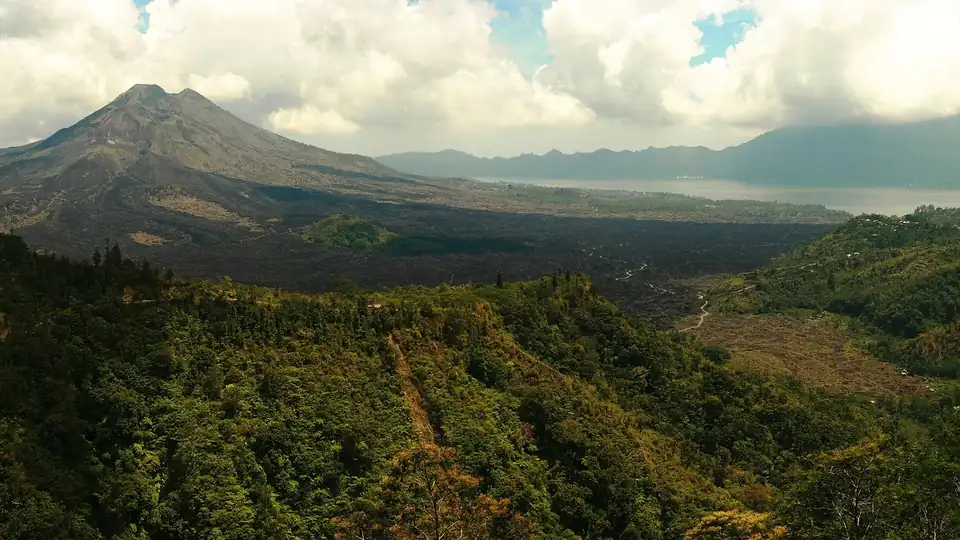
In 1963 nature struck. Mount Agung, the highest peak on Bali and the holiest place in its religion, erupted with great violence. Ash, rock and lava destroyed villages, buried farmland and killed well over a thousand people, while many thousands more lost their homes and land. For a farming society the loss of fertile ground was a lasting blow, and some of those displaced were later resettled to other islands.
The disaster carried a heavy spiritual weight. It came while the Eka Dasa Rudra, the greatest of Balinese purification ceremonies, held only once in a century, was being conducted at the Besakih temple on the mountain’s slopes. That the sacred volcano should erupt during its own supreme rite struck many Balinese as an event of deep and troubling meaning, and it deepened the sense of a world out of balance.
The killings of 1965 and 1966
Worse followed. In late 1965 an attempted coup in Jakarta triggered a nationwide campaign against the Indonesian Communist Party and anyone associated with it. Across the country enormous numbers of people were killed, and Bali was among the regions that suffered most severely. The violence of 1965 and 1966 tore through the island’s villages and set neighbour against neighbour, leaving wounds that families carried in silence for decades.
The scale of the killing on Bali was among the highest anywhere in Indonesia relative to its population, and it remains a painful and long-unspoken chapter. By the end of the 1960s the island was exhausted, impoverished and scarred by war, eruption and political terror. Out of that low point, however, came a period of stability under the new national government, and with it the beginnings of the tourism boom that would remake Bali yet again, the subject of our history of modern Bali.