
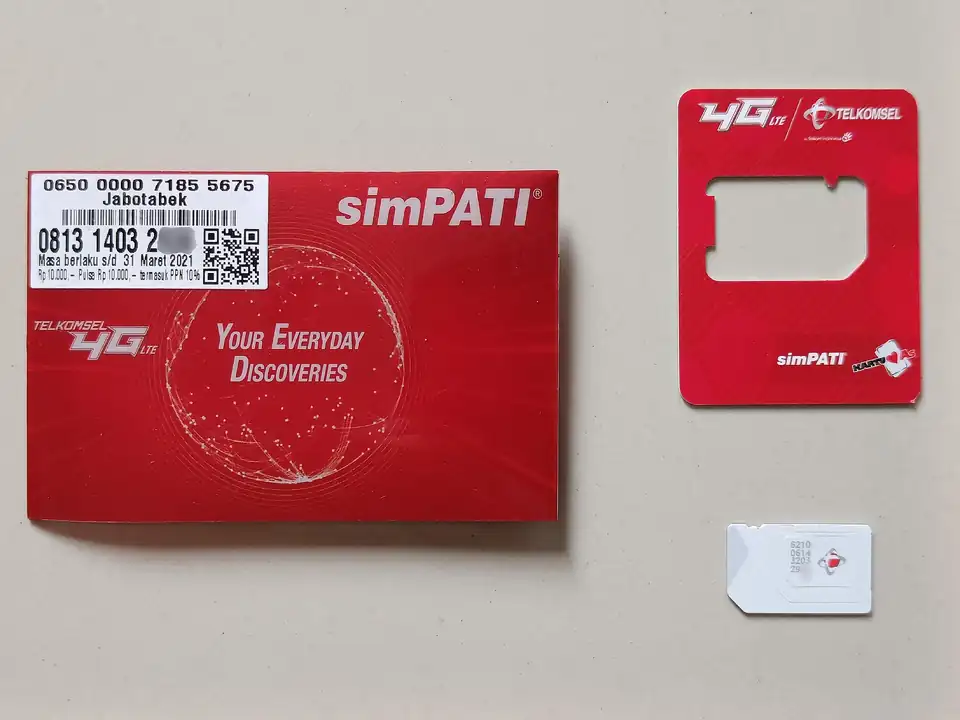
For most visitors an eSIM is the easiest way to have mobile data in Bali, because you install it at home and it works when you land. A physical SIM from a booth or shop is still a sound choice, and it is the only route if your phone does not support eSIM. This page sets out the options, the three networks, what registration involves, what recent sources say about the IMEI rule, and a table of eSIM prices taken from the providers’ own pages on 7 October 2026.
eSIM or physical SIM
An eSIM is a digital SIM installed from a QR code, so there is nothing to hand over at a counter. A physical SIM is a card you buy on arrival. Both connect to the same local networks. A Bali villa agency’s guide titled for 2026, which shows no publication date, says eSIMs “rely on the same local networks (like Telkomsel, Indosat)”.
The practical differences are small. An eSIM can be set up before you leave and used at the airport. A physical SIM means finding a booth or shop, and the same guide says you must register with your passport, with the shop or provider handling the process. A physical SIM also suits a phone without eSIM support, or a longer stay, when a local shop’s package can be cheaper than a travel eSIM.
Which phones support eSIM
Holafly’s Indonesia page says all smartphones with eSIM technology enabled are compatible, including recent iPhone, Samsung Galaxy and Google Pixel models. A 2026 Bali guide adds that your phone must be unlocked and eSIM-compatible, and says most newer phones from 2019+ are. If your phone is locked to a provider at home, the same guide says you will not be able to use a local SIM or eSIM in Bali.
Check your phone’s settings for an eSIM or “add cellular plan” option before you buy, and check each provider’s compatibility list, which most of them link from the plan page. Many phones with an eSIM also take a physical SIM, so you can keep your home number active for messages while the eSIM carries data. Holafly’s page warns that a home SIM left on may still trigger roaming charges for calls and texts, so switch roaming off.
eSIM prices compared
We checked seven providers’ own Indonesia pages on 7 October 2026: Airalo, Holafly, Nomad, Saily, Ubigi, Klook and Telkomsel. Three showed plan prices in the saved page text, so the table has three rows. The other four are left out, because their pages showed no usable prices (Saily, Ubigi and Telkomsel) or only a placeholder “per SIM card” figure with no plan sizes (Klook). We did not estimate any figure.
| Provider | Smaller plan | Larger plan | Local number or calls | Network named for Indonesia |
|---|---|---|---|---|
| Airalo | 3 days, unlimited GB, 10.50 € | 30 days, unlimited GB, 63.00 € | Not stated on the page | 3SinyalKuatHemat(Hutchinson), plus 2 others |
| Holafly | 3 days, unlimited data, $ 11.90 USD | 30 days, unlimited data, $ 76.50 USD | No local number, data only | XL (Excelcom) / Telkomsel |
| Nomad | 1 GB, 7 days, EUR 3.56 | 50 GB, 45 days, EUR 36.44 | Some Nomad eSIMs include one; check the plan | Telkomsel |
Prices as listed on each provider’s site on 7 October 2026; they change often.
Read the table with care, because the plans are not like for like. Airalo and Holafly list unlimited plans by day, and Nomad lists fixed amounts of data. Nomad’s page also shows a 5 day unlimited plan at EUR 16 and a 10 day one at EUR 29.33. The currencies differ too: each site showed its prices in the currency it chose for our visit, and a reader in Australia or the US may see different figures in their own currency. We have not converted them, since the exchange rate moves daily. Holafly’s page says its plans are for data only. Airalo’s page says calls and texts are available only “if included with your eSIM”, and does not say so for Indonesia.

The three networks and where they reach
Indonesia’s three main mobile networks for visitors are Telkomsel, Indosat Ooredoo (sold as IM3) and XL Axiata. A 2026 guide from a Bali villa agency ranks them as follows. Treat it as one view, since it is a commercial source and not a coverage survey.
On Telkomsel, it says the signal is the strongest and most reliable across the island, and “the only provider that consistently works well in remote areas like the cliffs of Uluwatu, the mountains of Kintamani, and throughout Nusa Penida/Lembongan”. It calls XL strong in Canggu, Seminyak, Kuta, Ubud, Sanur and Denpasar but patchy in mountainous and remote areas, and says XL may not be as reliable as Telkomsel on Nusa Penida. For Indosat, it says coverage is good in major towns and weaker in rural Bali and the Nusa Islands.
If you plan to stay in the south and use maps and ride apps, all three should do. If you will go to the east coast, the hills or the Nusa islands, the same guide points to Telkomsel. Our getting around Bali page covers the routes.
Physical SIM prices at the airport and in town
The same 2026 guide gives approximate prices for 30 day tourist packages. For Telkomsel it gives IDR 150,000 to 300,000 for 10 to 25 GB at the airport, and about IDR 100,000 for 10 GB as a local package in a store. For XL it gives IDR 100,000 to 250,000 for 15 to 30 GB, and for Indosat IDR 80,000 to 200,000 for 15 to 35 GB.
On where to buy, it says the airport is “fast, easy, but slightly higher prices”, and that official provider stores in places such as Canggu, Seminyak, Kuta, Denpasar, Sanur and Ubud are cheaper and have more packages. It also says shops and convenience stores are everywhere, but that you should make sure they actually register your SIM, because some do not. These are guide prices and not published tariffs, so confirm the package at the counter. Our Bali airport page covers the arrivals hall, and is Bali expensive puts a SIM in the wider budget.
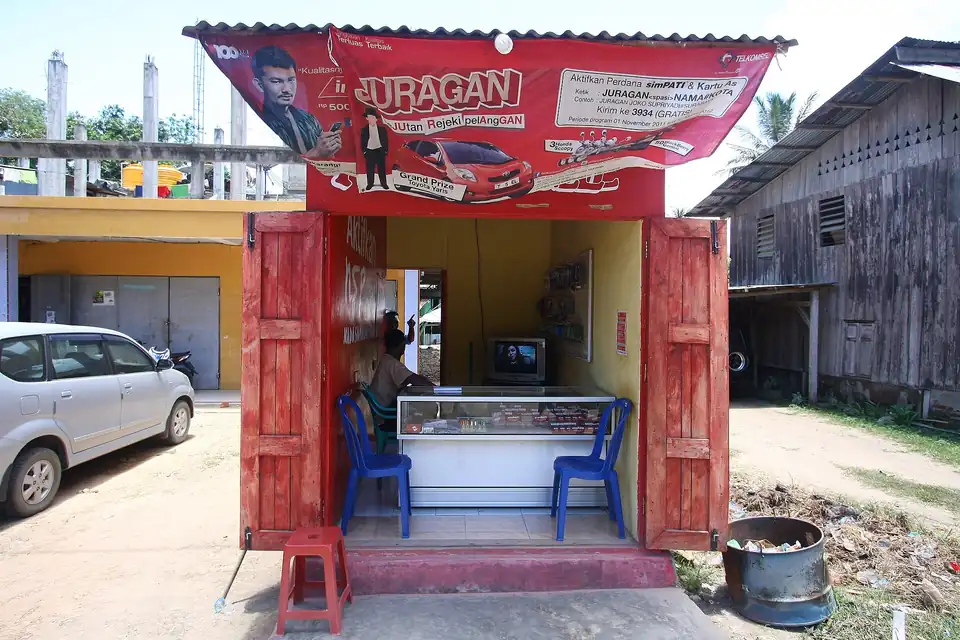
Small stalls like this one, photographed elsewhere in Indonesia, are where the registration point matters most.
Registration and the IMEI rule
Two separate things are easy to confuse. SIM registration identifies you as the subscriber. IMEI registration concerns the phone itself.
For SIM registration, a 2026 guide says foreigners must register with a passport. A 21 August 2026 expat guide says that from 1 July 2026 biometric verification became mandatory for new mobile registrations nationwide, using facial recognition, and that it applies to new physical SIMs and eSIMs alike. It says foreigners use their passport and residence documents rather than an Indonesian ID. It also says XL’s tourist eSIM can be bought online with passport, email and IMEI details, and that Telkomsel’s standard prepaid eSIM requires a KITAS for foreigners. Our arrival card page covers the other paperwork on entry.
For the IMEI rule, the sources differ. The 21 August 2026 expat guide says visitors staying up to 90 days can use an Indonesian SIM with temporary operator-based IMEI access, and that this matters most for people staying long term. A 2026 Bali guide says you do not have to register your phone’s IMEI with customs if you stay under 90 days. A rules database, last verified 26 July 2026 and marked low confidence, says IMEI registration with customs is required on arrival for any phone that will use Indonesian SIM cards beyond a short roaming grace period, and that phones on international roaming are unaffected.
The newest source is the 21 August 2026 expat guide, and it agrees with the Bali guide, so for a short tourist stay we read the rule as: no IMEI registration for up to 90 days. We could not confirm this against an official customs page, and the database above says to verify with the customs authority. Check with customs or your provider before a long stay. That 2026 Bali guide describes a long stay where the airport told a traveller IMEI registration was needed, and says an eSIM avoided the problem. Note that the expat guide says an eSIM does not remove the IMEI question.
Wifi, apps and how much data you need
Wifi in hotels and cafes is a fallback, but it is not a plan. Ride apps need a working connection at the moment you book, and our Grab and Gojek page quotes a travel guide that says relying on free wifi will not cut it. Having data in the street also lets you use maps, translation and messaging without searching for a signal.
For light use, a small plan is enough. Maps and ride apps use little data, while streaming and video calls use far more. Unlimited plans suit heavier use, and a fixed plan with a long validity suits a short or relaxed trip. If you plan to work from cafes on a laptop through your phone’s hotspot, data goes fast, so check whether the plan allows tethering. Holafly’s page says its plan shares 1 GB of data per day by hotspot.