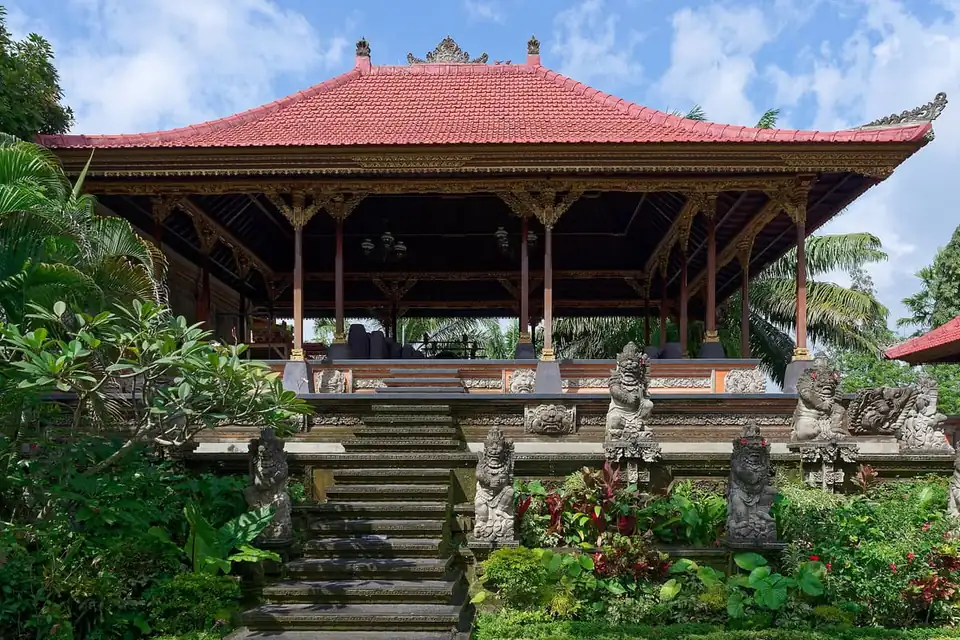
Ubud Palace, properly Puri Saren Agung, sits at the crossroads where Jalan Monkey Forest meets Jalan Raya Ubud, directly across from the market, so you will pass it sooner or later. It is free to go in by day, quick to see, and it comes into its own after dark, when the front courtyard becomes Ubud’s best setting for Balinese dance.
It is not a museum. The royal family still owns it and still lives in parts of it, which is why some doors are shut.
A palace from Ubud’s royal century
Ubud’s royal houses grew out of the kingdom of Sukawati. In the 17th century, as new kingdoms rose across Bali, a prince from Klungkung was sent to build a palace at Sukawati, and artisans from all over the island came to work on it and settled there. Sukawati is still known for its dance and music. In the late 1700s Sukawati sent retainers north to secure the Ubud area, and after fighting between rival villages, princes were posted out to build palaces and keep order. The palace you see was built in its present form, in the traditional Balinese style, during the reign of Tjokorda Putu Kandel, from 1800 to 1823.
Ubud’s kings ruled from here until the 1940s. The last ruling monarch, Tjokorda Gede Agung Sukawati, lived from 1910 to 1978, and his family still owns the palace.
Lempad’s stone and the 1917 earthquake
The earthquake of 1917 badly damaged the palace. Because the family lived in it, it was repaired quickly. Many of the carvings are the work of I Gusti Nyoman Lempad, the sculptor and architect who also designed Pura Taman Saraswati on the same main road, and who lived from around 1862 to 1978.
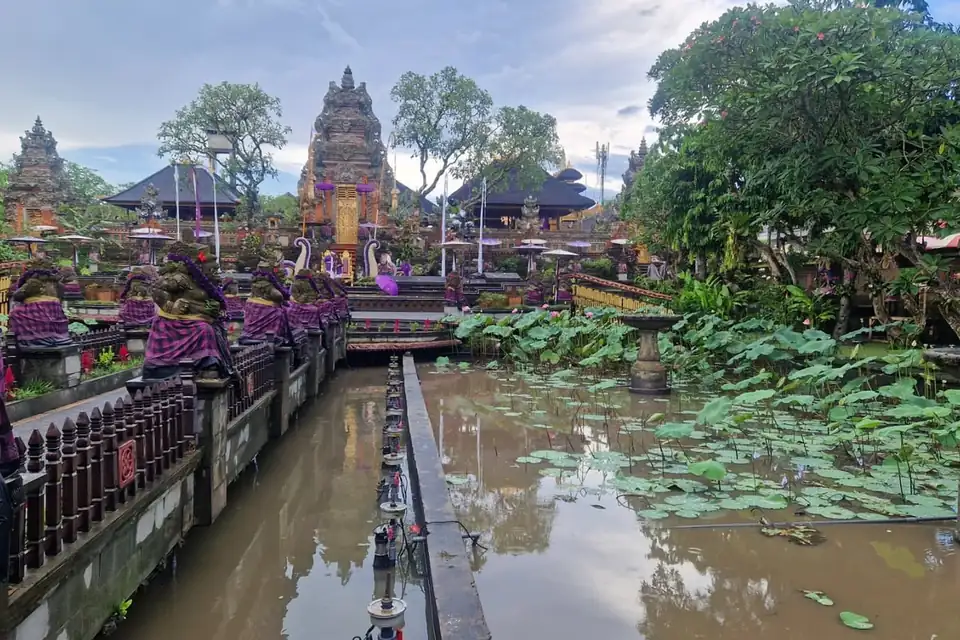
In 1928 the palace opened its doors to foreign guests, which makes it one of the first hotels in Ubud. To the north is Pura Marajan Agung, the royal family’s private temple, and in the enclosure in front stands a large Bengal fig.
The favourite photograph is of the candi bentar, the split entrance gate in red brick with carved stone and wood.
A different dance every night
The palace is best known for its dance. Performances are staged in the main courtyard every night from 7.30pm to 9pm, against a backdrop of carved doors and guardian statues, with a gong kebyar orchestra. They are put on by Sanggar Tedung Agung, a studio with four troupes that take turns.
The programme published in 2024 ran: Sunday, the Legong of the Mahabharata epic; Monday, Legong and dance; Tuesday, Legong and Ramayana; Wednesday and Friday, Legong and Barong; Thursday, Legong Trance and Paradise Dance; Saturday, Legong. Tickets are Rp 100,000, bought at the palace. The courtyard seats about 200. The organiser told detikTravel that even in the quiet season around 120 people come, mostly foreign visitors, so come early for a seat near the front. The stories change night to night, from episodes of the Mahabharata and Ramayana to the Legong and the Barong.
Free by day, ten minutes without a guide
By day the outer courtyards are open and free; Wikivoyage reckons on 10 to 15 minutes without a guide. Opening times quoted vary between about 8am or 9am and 5pm or 6pm.
The junction outside has a near-permanent traffic jam, so arrive on foot. Coming from Denpasar takes about 50 minutes by road, and the Trans Metro Dewata bus runs into town.
Ubud Market is directly opposite. It is a two-storey warren of carvings, batik and sarongs aimed at visitors, and Wikivoyage warns that traders think nothing of asking ten times the going price, so get a sense of prices before you buy. A late-afternoon look round followed by the 7.30pm show is the efficient way to do it.
From here the Sacred Monkey Forest is a walk south down Jalan Monkey Forest, and the Campuhan Ridge Walk starts a short way west. For somewhere to stay within walking distance of the palace, see where to stay in Ubud.