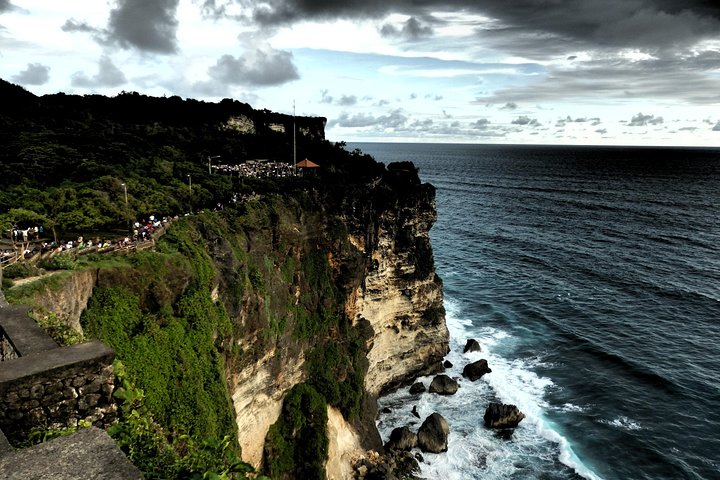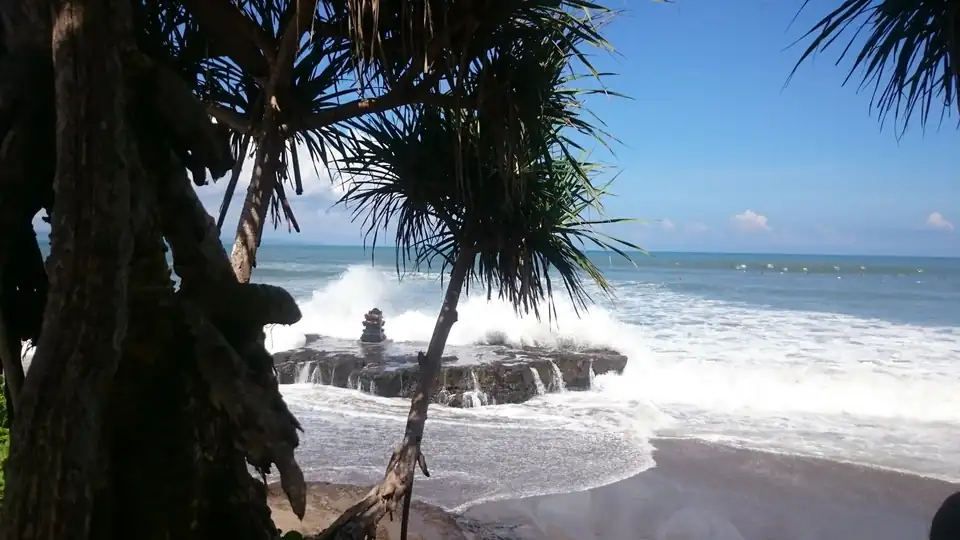
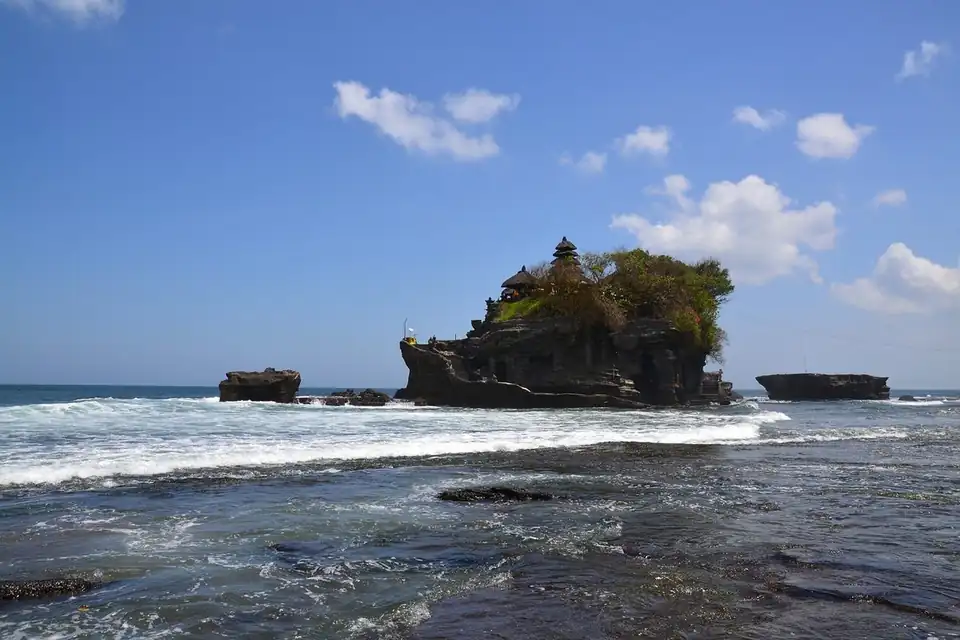
Tanah Lot is a rock formation off the coast of Beraban village in the Kediri district of Tabanan Regency, about 20 km northwest of Denpasar, with the temple Pura Tanah Lot on top. The name means land in the sea. Although this site files it under Canggu, it is across the regency border, about 13 km from Canggu, a drive of 30 to 50 minutes. It is one of Bali’s seven main sea temples along the southwestern coast, and its main deity is the sea god, Dewa Baruna or Bhatara Segara.
The rock, the legend and the concrete
Tradition credits the temple to Dang Hyang Nirartha, the 16th-century priest who is said to have spent a night here on his travels through Bali, Lombok and Sumbawa, and who is also worshipped at the temple. The Indonesian account goes further: Nirartha moved the rock out to sea by his own power, built the temple on it, and turned his shawl into a snake to guard it.
What you see is partly modern. In the 1980s the rock face began to crumble, and over a third of the visible rock is now artificial, built during a Japanese-funded stabilisation programme. Two-tonne tetrapods were first placed in front of the temple in 1987, and the main protection works ran from June 2000 to February 2003 with a loan from the Japan Bank for International Cooperation.
What the ticket gets you
The ticket buys a managed coastal park, run as DTW Tanah Lot by a Tabanan Regency body, not entry to the temple. Non-Hindus cannot go into the shrines on the rock, at any tide. From the gate it is about 500 metres through market lanes to the first view of the rock, five to ten minutes on foot, and the chain of clifftop viewpoints runs about another 500 metres.
The rock sits only 20 to 30 metres offshore. At low water a rock-and-sand causeway is exposed and you can walk to its base, where a freshwater spring called Tirta Pabersihan comes out and an attendant gives a short blessing. There is no posted price; reported donations fall somewhere between Rp 10,000 and 50,000. A grotto nearby holds one or two banded sea kraits, treated as guardians. They are venomous.
About four minutes’ walk along the clifftop is Pura Batu Bolong, a second sea temple on a promontory undercut by a natural arch, included in the same ticket. Between the two, the small Pura Enjung Galuh headland gives a view of both temples from one spot. Do not type “Batu Bolong” into a map to get here: it sends you to the beach in Canggu, 13 km away, which has its own Pura Batu Bolong.
Prices, hours and the 2026 increase that did not happen
Entry is Rp 75,000 for a foreign adult and Rp 40,000 for a foreign child; Indonesian visitors pay Rp 30,000 and Rp 20,000. Parking is Rp 3,000 for a motorbike, Rp 5,000 for a car and Rp 10,000 for a bus. In December 2025 the management announced that from 1 April 2026 foreign adults would pay Rp 100,000 and children Rp 60,000. On 29 March 2026 it postponed the rise, citing the conflict in the Middle East, and kept the old prices. Many websites already print Rp 100,000; others still print Rp 60,000, which has been out of date since the start of 2024.
Everything at the gate is cash only, and there is no ATM on site or online booking. The site closes at 19:00. Opening times in print vary between 06:00 and 07:00.
Sunset, the Kecak and getting home
Sunset falls between about 18:05 and 18:50 depending on the month. Arrive at 16:30 to 17:00 to park, walk the market and find a place before the crowd peaks between 17:30 and 18:30. In the July 2026 school holidays the site counted 3,000 to 5,000 visitors a day, 1,000 to 1,500 of them from abroad. A Kecak and fire dance runs at the Surya Mandala stage from roughly 18:00 to 19:00, for Rp 100,000 at the door, so you choose between the show and the viewpoints.
The temple anniversary, or pujawali, comes round every 210 days. In 2026 it ran from 1 to 4 July, and the site stayed open throughout.
Plan the trip home before you leave. Grab and Gojek can drop you here but generally cannot pick you up, and the return to Seminyak or Kuta often takes one to two hours. For a base nearer the coast, see where to stay in Canggu, and for the rest of the area, our guide to Canggu and the list of things to do in Canggu.