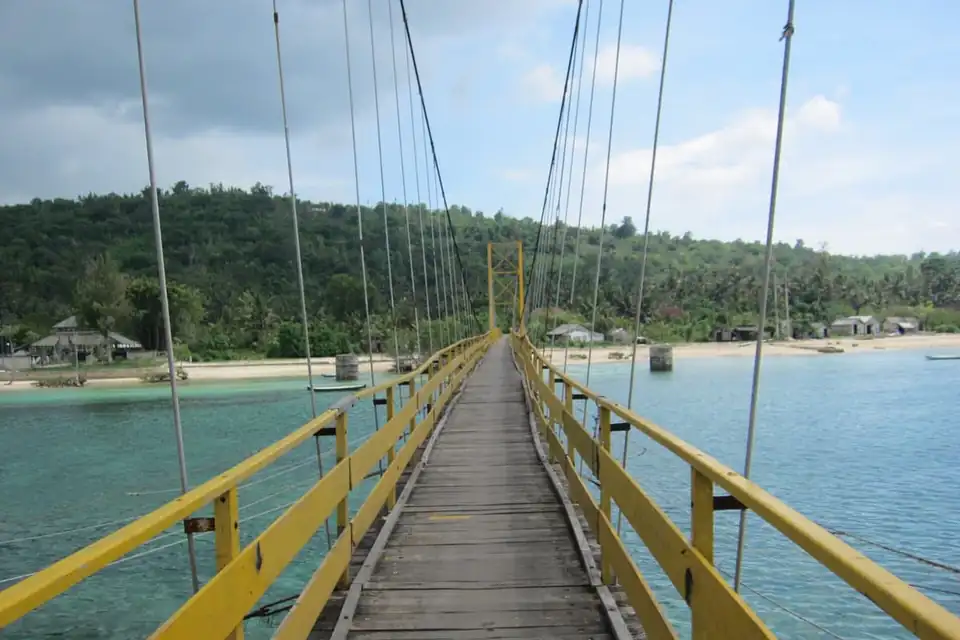
The Yellow Bridge, also known as the Love Bridge, joins Nusa Lembongan to Nusa Ceningan across a shallow channel of seaweed farms and mangrove forest. It is narrow, painted yellow and carries only people and motorbikes. It is also a memorial of sorts: the first bridge here collapsed in 2016 with fatal results, and the one you cross today was built to replace it.
History
The Yellow Bridge was built in 1996 as a suspension bridge for pedestrians and two-wheeled vehicles. On 16 October 2016 it collapsed, cutting the link between the two islands and causing fatalities. Reports put the number of dead at eight. Wikipedia says the bridge gave way during a religious procession, while the Deputy Governor of Bali said it broke because of erosion and the age of the structure.
The Ministry of Public Works paid for the rebuild with Rp 3.4 billion from the state budget. Work began on 10 November 2016 and finished on 9 March 2017. The engineers kept the existing sub-structure and made a framework from stock they already held, so the job went faster. The bridge was blessed in a Hindu ceremony on 25 February 2017, and formally inaugurated on 31 March 2017.
The bridge today
The Ministry of Public Works gives the length as 138 metres, in three spans of 24, 90 and 24 metres. Antara, a local news agency, gives 140 metres, and the rebuilt bridge is 0.2 metres wider than the old one. Sources differ slightly, and the difference does not change how you cross it.
In the evening the bridge is lit with coloured lights, which were fitted soon after the reopening. Antara reported that hundreds of foreign visitors gathered near it each evening to watch the sunset. Below the deck, the channel between the islands is shallow, and it is difficult to navigate by boat at low tide.
A second bridge is planned. In September 2025 the Klungkung public works office said a new Lembongan to Ceningan bridge would be built in 2026, with a proposed cost of Rp 112 billion, so that four-wheeled vehicles can cross. It would be separate from the Yellow Bridge and would make better use of Bias Munjul harbour. We found no report that building has started.
Crossing to Nusa Ceningan
The estuarine channel under the bridge is home to many seaweed farms and mangrove forests, so it is worth a look from the deck before you ride on. Nusa Ceningan has been slowly growing in popularity since 2009, while Nusa Lembongan remains the only one of the three islands with significant tourism infrastructure. Nusa Ceningan is 3.9 kilometres long and 1.1 kilometres wide, with an area of 3 square kilometres, and it is a short distance from Nusa Penida. It has two hamlets and a population of 1,523, as well as scenic roads and paths, and the westward views back over Lembongan to Bali are impressive. Sunset over Bali from the central ridge is worth the effort. One well-known attraction is the Mahana cliff jump on the south-west side, with platforms at 5 and 13 metres. Jumping is only permitted when the tide is high enough.
Combine the crossing with Mushroom Bay on the Lembongan side, or with Dream Beach and Devil’s Tear on the south-west coast. More ideas are in things to do in Nusa Lembongan, guided tours and where to stay.