
Month by month
Bali in May
The month the odds cross over: dry in 23 of the last thirty years, against April's 13.
May is where the Bali year stops being a gamble. April came in dry in 13 of the last thirty years, which is worse than a coin toss. May managed 23.
The monthly averages barely hint at that. April is 134mm and May is 80mm, a fall of 40 per cent, which reads as a modest improvement. The chance of getting a dry month improves by 77 per cent, roughly 1.9 times as much. That gap between what the average says and what the odds say is the most useful thing about May, and it is invisible on every chart that shows only the mean.
This page contains affiliate links. If you book through them we may earn a small commission, at no additional cost to you. It helps keep this guide free.
What May actually measures
On the chart May is the first bar in the low run, the start of the flat stretch that lasts until October.
Rainfall
80 mm
On average. An independent check at the same point puts it at 82mm.
Dry years
23 of 30
Under 100mm, against April's 13. The year’s largest step across the halfway line.
Wettest year
246 mm
A bad May is still possible. This is a good bet, not a certainty.
The monthly average has two independent sources behind it and they agree to within three per cent. The dry-year count and the wettest year come from the reanalysis alone. The 100mm line is ours, about three millimetres a day. As on the other month pages there is no count of rainy days and no separate figure by region.
The month the odds cross over
Run the dry-year count around the calendar and the year turns out to have two hinges rather than a gradual slope. Coming out of the wet season, April sits at 13 of thirty and May at 23: the first month on the record whose predecessor is below half and which is above it. Nothing else in the year does that going up. Going the other way, November is the mirror, and this site's October page covers that end of it.
Why that matters more than the millimetres: a monthly average is a description of thirty years, and you are booking one. What you actually want to know is the chance that your particular fortnight is a dry one, and between April and May that chance goes from unlikely to likely while the average moves by less than half as much. Anyone comparing the two on rainfall figures alone is reading the smaller of the two signals.
The practical version is short. If your dates can be either April or May, take May, and do not be talked out of it by how close the averages look. If they are fixed to April, read that page: the second fortnight is markedly drier than the first, which is the one lever April gives you.
May or June
Once you are past the crossing, the dry-season months stop separating much. June is drier on average, 62mm against 80mm, and marginally more reliable at 24 of thirty against 23. Its ceiling is also lower: the wettest June in the record was 172mm against May's 246mm.
So June wins narrowly on every weather measure, and May wins on the two things the data does not hold: it is earlier in the run-up to the peak, and it is the cheaper and quieter of the two for that reason. If the weather has to be as good as it can be without paying peak prices, June. If you want the dry season with the fewest people in it, May is the first month that has one and the last before the build-up starts.
Where to base yourself in May
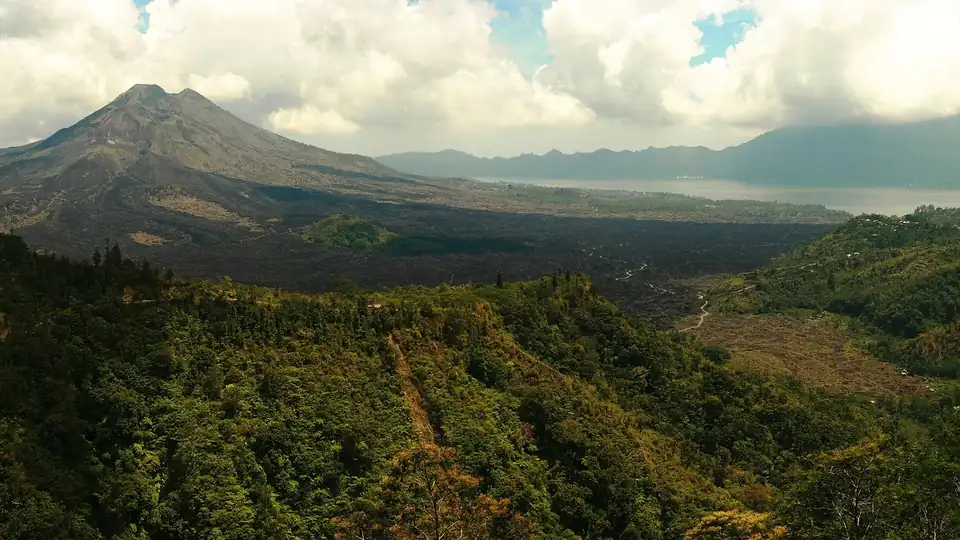
May is the month the highlands come back. They catch more cloud and rain than the lowlands all year, so Kintamani and Munduk are nights rather than bases through the wet season; from May a Batur sunrise or a Munduk waterfall walk is a reasonable plan rather than a coin toss, and it is a plan you will have largely to yourself.
On the coast the west side is working, so Uluwatu and the Bukit are in season and Canggu and Seminyak have the dry-season version of themselves two months before the queue. This is a good month for the split stay that the wet season makes a gamble: coast and mountains in one trip.
All twelve bases, with what the airport transfer costs to each, are on our where to stay in Bali page.
What May is good for
Booking with confidence, which is not something the first four months of the year allow. Everything that needs the sky to cooperate becomes schedulable: the volcano at dawn, the day or the night on Nusa Penida, the long drive north. Our surfing guide has the west-coast season, which is properly open by now.
It also catches the island between two states. Six months of rain have left the terraces and waterfalls in good condition, and the drying that strips them back by August has only just started. May gets more of the green than any other dry month and more of the sun than any wet one.
For how May sits against the other eleven on crowds as well as rain, see when to visit, and our weather guide for the pattern across the year.
Every month of the Bali year, with its measured rainfall and what the average hides, is on Bali month by month.
Bali in May: common questions
What is the weather like in Bali in May?+
Dry-season weather, newly arrived. May averages 80mm in the southern lowlands and came in under 100mm in 23 of the last thirty years, against April's 13. Daytime highs are 30.6C and nights 24.6C. It is the first month of the year where a dry trip is the likely outcome rather than the hoped-for one.
Is May a good time to visit Bali?+
It is one of the best, and it is the first month you can book with real confidence. The dry season has arrived, the July and August crowds are two months away, and prices have not moved. The only months that beat it on odds are the peak ones and September, and May is cheaper and emptier than any of them.
Is April or May better in Bali?+
May, and by more than the averages suggest. April averages 134mm and May 80mm, a fall of 40 per cent, which sounds like a modest improvement. The odds tell a different story: April came in dry in 13 of thirty years, worse than a coin toss, and May in 23, better than two in three. The chance of a dry month improves by 77 per cent, about 1.9 times as much as the average falls.
How often is May dry in Bali?+
In 23 of the last thirty years it delivered under 100mm, our threshold for calling a month dry. That is the same figure as October and just behind June's 24. The wettest May in the record was 246mm, so a bad one is still possible; it is a good bet rather than a certainty.
How hot is Bali in May?+
About 30.6C by day and 24.6C at night. Bali's hottest and coolest months are barely two and a half degrees apart, so May feels like every other month. What the month choice buys you is rain and crowds, and in May both are moving in your favour at the same time, which is unusual.
Is the surf good in Bali in May?+
Yes, and it is one of the best months for it. The southeast trades are established, so the west-coast reefs of the Bukit at Uluwatu, Padang Padang, Bingin and Balangan are working, and the crowd that fills them from July is still two months off.
Are the boats to Nusa Penida reliable in May?+
Considerably more reliable than in the wet season. The fast boats from Sanur are cancelled when the sea is rough, and rough days have thinned out by May. An island day is safe enough to schedule normally, though it is still better placed in the middle of a trip than on the last day of one.